Janitorial Services Singapore: How They Support Cleaner Workplaces
The best evidence that a janitor is doing the job well is that nobody mentions it. Soap is always there, the corridor is dry, the bins never smell, and the day proceeds without anyone thinking about why. Because the work is invisible when it succeeds, it is hard to assess from a proposal. Seven simple tests, carried out on site, reveal far more about janitorial services singapore providers than any list of promised duties.
A Janitor Stays; a Cleaning Crew Visits
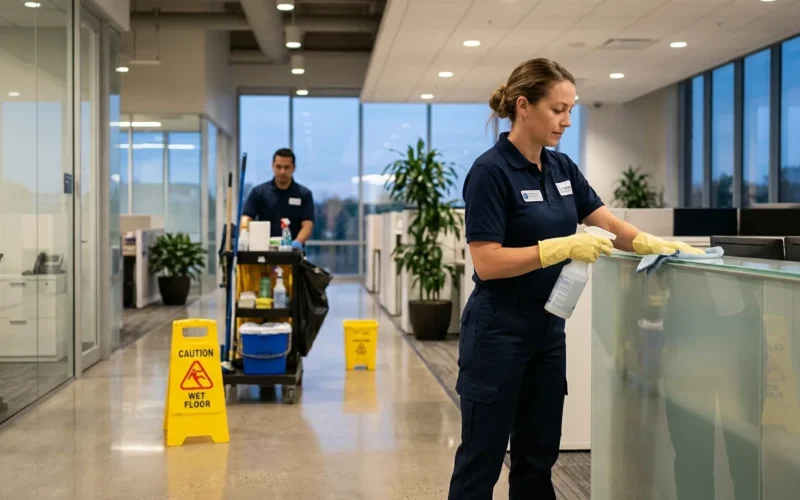
A contract cleaner typically visits, completes a routine and leaves. A janitor stays. The role combines scheduled cleaning with continuous upkeep through the working day: patrolling washrooms, replenishing supplies, clearing spills, removing waste as it accumulates, setting up meeting rooms and reporting faults such as a dripping tap or failed lamp. It suits schools, clinics, larger offices, malls and industrial buildings where footfall keeps undoing the morning’s work and someone must be present to restore it.
Test One: The Washroom at Three O’Clock
Anyone can present a clean washroom at eight in the morning. Visit at three in the afternoon, after the lunch rush. Is the floor dry, are the bins below the brim, is there soap in every dispenser and paper in every cubicle? Is the inspection sheet on the door initialled at intervals that match the time, or filled in ahead? The mid-afternoon condition shows whether rounds are happening or merely scheduled, and it is the condition most occupants actually meet.
Test Two: The Store Cupboard
Open the janitor’s cupboard. Order here predicts order everywhere. Chemicals should be in labelled containers with safety data sheets nearby, never in reused drink bottles. Mops should hang to dry, not sit sour in a bucket. Cloths should be colour-coded so that those used on toilets never reach a pantry counter. Stock of tissue, soap and liners should be enough for several days, with a simple record of what was last ordered and when the next delivery is due.
Test Three: The Spill Drill
Tip a cup of water in a corridor and time what happens. A capable janitor arrives with a sign, mops, dries and removes the sign within minutes, because wet floors are how people get hurt. Ask how staff are meant to summon help: a telephone number, a messaging group, a button at reception. An on-site janitorial contractor should be able to state its expected response time and show how requests are logged and closed, not merely promise that someone will come.
Test Four: The Bin Route
Follow the waste. Bags should be tied, carried or carted without dripping, and taken by a set route that avoids the front lobby at busy times. Recyclables should remain separated all the way to the bin centre, since mixing them at the last step is common. The bin centre itself should be rinsed regularly with lids kept shut. Smell, flies or stains along the route mean the timing or the containers need changing, and a good janitor will have noticed first.
Test Five: The Stairwell and the Corners
Lobbies are easy. Check the places supervisors seldom walk: fire stairs, the service lift, the corridor behind the pantry, the base of pillars in the car park. Run a finger along a handrail and look at the corners of each landing. A janitor who keeps these in order has a systematic round. One who does not is cleaning for the audience. Stairs must also be clear of stored boxes, which is a safety matter as much as a cleaning one.
Test Six: The Logbook
Ask to see the daily record. A useful log lists rounds completed, consumables used, incidents attended and defects reported to the building’s management, with times. It need not be elaborate, and many firms now use a telephone application with photographs. What matters is that faults noticed by the janitor, such as a leaking cistern or loose tile, reach someone who can fix them. That reporting habit is one of the role’s most valuable and least advertised contributions.
Test Seven: The Handover Note
Find out what happens when the regular janitor is on leave. Is there a written routine for the site, with a floor plan, the timing of rounds, the location of stopcocks and the names of contacts? Has the relief worker been shown round? Buildings suffer most during absences, and a provider that plans for them shows it understands the job depends on a system, not on one conscientious individual’s memory. Ask to read the note itself.
The People Behind the Results
Results come from how staff are employed and led. Cleaning firms must be licensed by the National Environment Agency, and cleaners fall under the Progressive Wage Model, which ties wages to skills and responsibilities. Ask about training, uniforms, protective equipment and how often a supervisor visits. Treat the janitor as part of the building’s team: introduce them to occupants and give them a proper place to rest and store belongings. Respect is repaid in diligence.
Scoring the Seven and Deciding
Run all seven at a site the bidder already serves, or at your own premises a month into a new contract. Score each honestly and discuss the weak ones with the supervisor. Renew or appoint on the evidence of the afternoon washroom, the cupboard and the logbook instead of on the number of duties listed. Chosen that way, janitorial services singapore firms earn their place by keeping a workplace clean when nobody is checking.