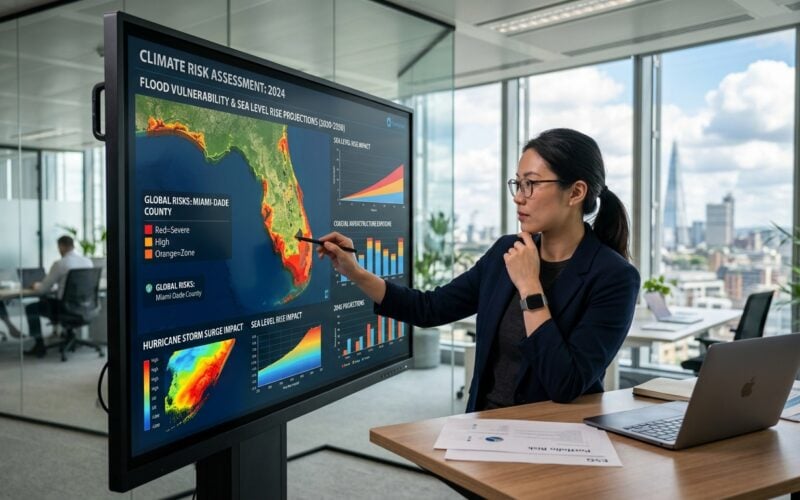
A Business Guide to Climate Risk Assessment
A climate risk assessment answers one question for a business: what could a changing climate cost us, and when. That sounds simple until a business tries to actually do it, at which point the question splits into a dozen sub-questions about which hazards matter, over what time horizon, at what resolution, and translated into which units, insurance premiums, asset values, capital expenditure, or operating costs.
Getting a useful answer means working through the assessment in a consistent order rather than jumping straight to a hazard map, which is where most assessments that never get used tend to go wrong.
Step One: Define the Decision the Assessment Serves
An assessment built for an acquisition decision looks different from one built for insurance renewal, which looks different again from one built for a ten-year capital plan. Each has a different time horizon and a different unit of measurement that matters. Skipping this step produces a technically accurate assessment that nobody downstream actually knows how to use.
Step Two: Quantify Hazard Exposure at Asset Level
Regional or city-level hazard data is a starting point, not an answer. Two buildings a few streets apart can face materially different flood or heat exposure depending on elevation, drainage, and orography, so the assessment needs to resolve down to the individual asset rather than stopping at a postcode-level estimate.
Step Three: Layer In Adaptation and Vulnerability
Raw exposure overstates risk wherever adaptation infrastructure is already doing its job. Flood barriers, upgraded drainage, resilient building codes, and a track record of effective emergency response all reduce the practical impact of a given hazard. AlphaGeo’s Global Adaptation Layer exists to bring this data into the assessment so exposure gets adjusted for what is actually protecting the asset, not just what could theoretically go wrong.
Step Four: Convert Risk Into Financial Terms
A hazard score means little to a finance team until it is expressed as a change in expected cashflow, insurance cost, or asset value. This is the step that determines whether an assessment gets acted on or filed away, since decision-makers act on dollars and timelines, not probability percentiles.
Businesses working through a climate risk assessment for the first time, or replacing an assessment process that stalled at the hazard-mapping stage, can use AlphaGeo’s platform to run all four steps through one connected assessment workflow rather than four separate exercises.
A well-structured climate risk assessment also improves communication between technical specialists and business leaders. Engineers, sustainability teams, finance departments, and executives often view climate information through different lenses. Presenting risks in a consistent and financially relevant format allows every stakeholder to understand the findings and contribute to informed decision-making without needing to interpret complex scientific datasets independently.
Regular assessments also provide value beyond immediate planning decisions. As climate projections evolve and businesses expand into new locations, periodic reassessments help organisations monitor changing conditions and identify emerging risks before they become costly problems. This proactive approach supports long-term resilience by ensuring that investment strategies, operational plans, and maintenance priorities remain aligned with the latest available information.
Ultimately, a climate risk assessment should function as a practical business tool rather than a one-time compliance exercise. By combining asset-level analysis, adaptation data, and financial modelling, organisations gain a clearer understanding of where resources should be allocated and which risks deserve immediate attention. This enables businesses to strengthen resilience, improve investment confidence, and make strategic decisions that remain effective in an increasingly uncertain climate.